Student Loans
15 reasons to ignore U.S. News & World Report’s college rankings


Most college-bound teenagers and their parents never look at U.S. News and World Report’s college rankings, which is actually a healthy thing.
U.S. News’ college rankings, are much more likely to be a preoccupation of teenagers and parents in affluent households. I believe the fixation with the rankings is a major reason for the tremendous stress and mental health issues that too many of these students experience.
It’s my hope that students and parents won’t put so much faith in them when they know more about these destructive college rankings work.
15 things to know about US. News & World Report’s College Rankings
1. U.S. News relies on rankings to stay alive.
U.S. News’ college rankings wields tremendous power even though the rankings giant is a shell of its former self. Many years ago, U.S. News couldn’t attract enough subscribers to keep the magazine going.
To survive, U.S. News issues junk rankings for all sorts of stuff including such things as hospitals, new and used cars, diets, nursing homes, high schools, law firms, jobs, real estate agents, vacations, cruises and health insurers! It’s all garbage. 

2. U.S. News’ college rankings have encouraged institutional bad behavior.
U.S. News’ college ranking system is one of the chief culprits for escalating college prices and encouraging harmful admission practices.
Millions of students have been adversely impacted by the rankings competition because of the actions of the audience that cares most deeply about the numbers – college presidents and their boards of trustees, and by extension, their admission offices.
For these folks, US News has provided them with an easy (though deeply flawed) scorecard to measure how their institutions are faring and they are distraught if their school’s ranking stalls out, or worse, drops.
3. The college rankings formula can be gamed.
Plenty of universities have figured out how to crack the code to climb up the rankings ladder.

Northeastern University is one of the schools that focused single-mindedly on improving their rankings. Two decades ago, Northeastern was considered an third-tier, blue-collar commuter school stuck with an unattractive campus.
But then a new college president took over and focused single mindedly on saving the institution by doing whatever was possible to boost its U.S. News ranking.
Six years ago, Boston Magazine explored this Cinderella tale and quoted the Northeastern president as saying, “There’s no question that the system invites gaming.”
U.S. News ranks Northeastern, which is now an extremely popular destination, as No. 40 in the coveted national university category. It is tied with such institutions as Tulane and College of William and Mary. A couple of decades ago it was ranked No. 162 and it was rare for anyone outside of Boston to have heard of it.
George Washington University was another struggling commuter school that successfully cracked the U.S. News college rankings code and began 

Here is an article from Washington Monthly about how ranking manipulation catapulted GWU in the rankings. It’s now ranked No. 70 in the national university category.
4. Popularity is a big ratings factor.
A school’s reputation among the right people will significantly impact it’s U.S. News ranking.
In annual surveys, three administrators from the offices of president, provost and admission at each school in the national university category, for instance, must assess what they think about all their peers on a one-to-five grading scale. (One is marginal and five is distinguished.)
Here, however, is the dilemma:
What do administrators at UCLA, Johns Hopkins, University of Tulsa and Kansas State know about what’s going on at Brandeis, Case Western Reserve, Virginia Tech and University of Missouri (my alma mater), much less 300 other schools in the national university category?
Or how about schools in the liberal arts college category that have far less name recognition. What do administrators at my son and daughter’s alma mater – Beloit and Juniata colleges – know about the academic quality at say, Pitzer, Hendrix, Spelman and Middlebury colleges?
Rating peers on one-to-five scale is an absurd exercise that administrators should refuse to do and most actually decline to participate in this rankings beauty contest exercise. According to U.S. News, only 43% of academics responded to the reputational surveys distributed in 2018-2019.
5. U.S. News measures six-year graduation rates.
I don’t know any parents who thinks that graduating from college in six years is acceptable. U.S. News, however, uses six-year rates when evaluating schools. Another head scratcher.
6. Rankings encourage colleges to favor affluent students.
US News awards schools which generate higher test scores and grade point averages for their incoming freshmen class, which favors rich students.
This focus on selectivity has been a boon for affluent high school students, who tend to enjoy better academic profiles. These teens can afford expensive test-prep courses and are more likely to have attended schools with stronger academic offerings. There is a strong positive correlation between standardized test scores and family income.
Attracting richer students allows the school to boost their sticker prices without alienating too many potential customers.
7. Rankings encourage the use of merit scholarships.
Before the rankings became so prominent, high-income students typically had to pay full price for college. The majority of grants were reserved for middle-class and low-income students, who required financial help.
But with the rankings premium linked to top students, private and public institutions began offering merit scholarships to entice smart, wealthy students to their campuses rather than to their competitors.
How do you cough up the money for these deal sweeteners?
One way is to raise the tuition price to generate extra revenue for these scholarships and another way is to reduce the financial aid to needy students. Low and middle-income students are the big losers in the rankings game.
8. Elite schools are the exception to merit awards.
The only schools that don’t offer merit scholarships to rich students are the institutions that are perched at the top of U.S. News’ college rankings.
Wealthy parents whose children get into the top-rated schools in U.S. News’ national university and liberal arts colleges categories, such as Stanford, Harvard, Princeton and Williams, will pay roughly $300,000 for a SINGLE bachelor’s degree, but they won’t do it for other schools.
The most elite schools boast that they reserve their aid to the families who need financial help to attend college, but most of these institutions offer admissions to a shamefully low percentage of needy students. The most elite schools primarily educate wealthy students.
9. Rankings encourage admission tricks.
For instance, US News’ algorithm favors schools that spurn more students. To increase their rejection rates, schools will court students through marketing materials and social media that they have no intention of accepting.
Here’s another trick: some institutions make it easy for students to apply via streamlined online applications, which are referred to in the industry as “fast apps.” Schools use this strategy to increase the size of their student body, as well as bump up their rejection rates.
10. Rankings don’t measure what’s important.
One of the perverse aspects about the rankings is that turning out thoughtful, articulate young men and women, who can write cogently and think critically won’t budge a school’s ranking up even one spot. Curiously enough, U.S. News doesn’t even attempt to measure the type of learning going on at schools.
In reality, the methodology fueling the rankings are a collection of subjective measurements that students and families are supposed to rely upon to pinpoint the schools doing the best job of educating undergraduates. U.S. News relies on proxies for educational quality, but these proxies are dubious at best.
11. Rankings encourage cheating.
Rankings have become such a high-stakes game that some schools send false data or have acted unethically. And I suspect that most of the schools that are manipulating their figures have never been caught. Those that have been outed in past years include Claremont McKenna, U.S. Naval Academy, Baylor University, Emory University.
12. Rankings encourage debt.
This is incredibly infuriating – the rankings giant ignores how much college debt students are incurring. It’s a terrible omission that is certainly one reason why college tuition continues to defy inflation.
US News rewards schools that spend freely and the rankings juggernaut doesn’t care if that requires universities to boost their prices and graduate students with staggering debt.
Here is an old post -that I wrote about this phenomenon for my previous college blog at CBS Moneywatch:
Blaming College Rankings for Runaway College Costs
Malcolm Gladwell wrote a fascinating article for The New Yorker in 2011 on college rankings in which he talked about the incentive of institutions to turn their campuses into lavish palaces and stick the bill with the kids:
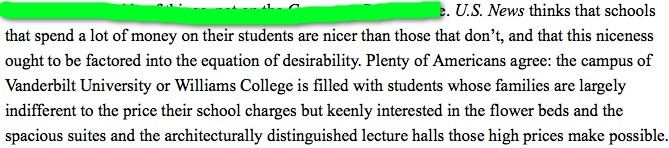
13. Don’t believe the numbers.
You should not believe that a college ranked No. 1 or 19th or 73rd is better than peers ranked 6th or 42nd or 95th best. I’ve seen too many parents make terrible financial sacrifices to send their kids to rankings darlings when it was completely unnecessary.
The school that you attend isn’t as important as what a student does wherever he or she lands. I wrote a post about my daughter six years ago that illustrates this fact.
14. Use U.S. News as a tip sheet.
Rather than focus on the numbers, consider using U.S. News rankings to generate ideas. This will be particularly helpful in searching for promising schools beyond the national university category, which includes nearly all of the nation’s best-known universities.
Try looking for ideas in U.S. News’ regional universities and liberal arts college categories and then start researching them.
15. U.S. News is here to stay.
A few years ago, Brian Kelly, the U.S. News editor made this promise during an press interview: “You can love us or hate us, but we’re not going away.”
Sadly, I think that is true, but using rankings responsibly can lessen the tremendous emotional and financial damage that they cause.
The post 15 reasons to ignore U.S. News & World Report’s college rankings appeared first on The College Solution.
——————
By: Lynn O’Shaughnessy
Title: 15 reasons to ignore U.S. News & World Report’s college rankings
Sourced From: www.thecollegesolution.com/15-reasons-to-ignore-u-s-news-world-reports-college-rankings/
Published Date: Wed, 24 Jun 2020 17:33:36 +0000
Did you miss our previous article…
https://getinvestmentadvise.com/student-loans/when-to-send-test-scores-to-test-optional-colleges/